Showing posts with label public pedagogy. Show all posts

Saturday, 10 November 2012

Stories and Truth


Storytelling is an art and it seems to me that it can be used to heal injustices and hurts caused by others. It involves a teller and an audience. It's as simple as that. Stories can be told by both men and women of all ages. In some cultures, it is men who hold the place as storytellers, and in other cultures, it is the women who lead in this role - many times in more private venues. Certainly fables tell us stories that communicate a lesson through indirect means - the tortoise took his time in his race against the hare and despite the hare's speed, the tortoise won as he was slow and methodical - the lesson . . . don't rush things and what is perceived as truth is not necessarily so.

Storytelling, like all the arts, provides an intuitive or non-discursive, way of knowing - offering up a fresh perspective of how we perceive our world. We are united in the relationships that are created in the process of either telling or by acting as listener and witness to the telling. Stories offer us an opportunity to get a glimpse of the Other and expand our imagination.

Stories are not always verbal. They can be told in a variety of ways and can be either fictional truths - truth with a bit of artistic license thrown in - or they can be a recounting of our personal experiences.

Below is an example in which visual art and the written word are combined as a means of storytelling. American photographer Judy Gelles worked with inner city fourth graders in various cities throughout the United States. The image and words below convey a personal story by just a few words and the image enhances the tale by creating a feeling of  . . . perhaps shame, perhaps barriers, or grief.


Stories can also be told without the use of words. Images alone and a moment of thought and imagination from the viewer/recipient, can communicate a wealth of information. When I was working throughout the Sri Lankan Jaffna Peninsula after the 2004 tsunami, I asked some young women to paint an image that would tell a story. The watercolour below was painted by an eighteen year old who had survived both the tsunami and the civil war. The image not only tells her own personal narrative, but also conveys a collective story that is representative of what so many experienced during this and other natural disasters.


I wonder though, can telling stories that are true sometimes re-open wounds? Is it sometimes better to forgive and forget in order to reconstruct our lives? Evidence has shown that sharing stories is an important part of individual's healing, but is it always beneficial? Is this notion yet another construct of the global north - one in which we impose our practice on those living in the global south? Is it applicable in all cases?  How do we, and why should we, retell narratives that might speak of atrocities when a community is trying to reconstruct their lives. For instance in post-war reconciliation where children have been both victim and perpetrators of violence, is it necessary for the victims of their violence to retell stories publicly, or is there a risk to the general well-being of those trying to re-integrate these children into the community? Does the risk out weigh the benefit?

In many ways telling truthful stories can help to rebuild a community but we must use caution - it is not a "one size fits all".




Sunday, 21 October 2012

Peace and strategic arts-based practice

In 1969 I was a child living in the Republic of Ireland when the Troubles started again in Northern Ireland. My grandmother lived in Belfast at the time, and my father would drive us there to visit her. When we came to the border, we were met by heavily armed border militia and the streets of Belfast were filled with trucks. The fear was palpable.

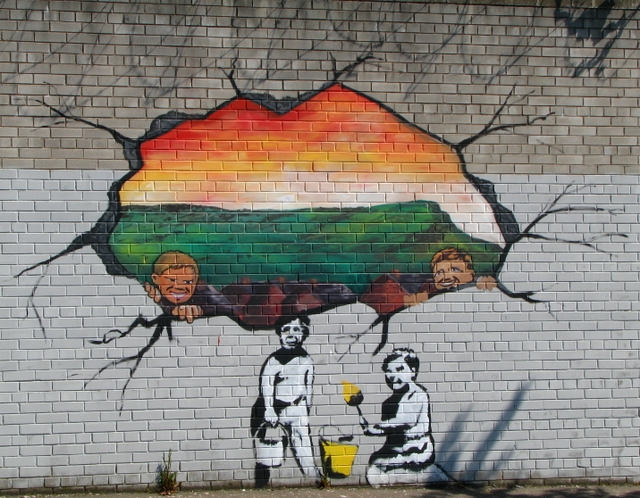
In response to the violence, artists created murals to either commemorate events or to communicate their hope for peace. The majority of the murals which were created along Falls Road and Shankill Road in Belfast reflect either the republican or loyalist political beliefs. When looked at together, they tell a tale of hardship and violence, but also of hope. For instance, murals depicting the 1981 hunger strike during which ten people died drawing international attention, commemorate the event. The leader of the hunger strike was an IRA member called Bobby Sands, his election into parliament gained international attention before his death. In fact, the hunger strike radicalised nationalist politics, and was one of the driving forces that enabled Sinn Féin to become a mainstream political party.


So, whether to advocate for peace or engage people in the struggle for justice, murals play an important role in mediating social change. In the case of the murals in Northern Ireland, the arts were not only used in an non-violent activist way, but also as a means to build peace and heal the community. Artists can raise awareness of latent local issues - or issues that are at the forefront of everyone's mind. Another example would be the the murals painted by Diego Rivera illustrating the repressed worker. These murals reflect not only Rivera's own communist leanings but also the political upheaval of the times and raised awareness of their struggle.

I find myself reflecting on this as I am very interested in the use of arts as a tool to facilitate community healing. The murals in Northern Ireland and Mexico City, the arts, were created as a means of public pedagogy and non-violent activism raising public awareness of issues and increase understanding and sympathy of others. At other times  the arts may be used as a means towards gaining solace. In Kenya during the Truth and Reconciliation Commission, song was used when a particularly violent testimony was heard. Song, in this instance, seems to have been not only therapeutic for the audience of the Commission who had just acted as witnesses by listening to stories of human rights violations, it appears to have eased the stress for the witness and the commissioners.

So in order for arts to be used in a productive way during community healing, it important for to reflect on when to use the arts, in what instance to use them (consider environment) and what artistic medium is best suited for what situation. So really, the what, the when and the how are important considerations when using the arts in peace building approaches.

Thursday, 20 September 2012

transforming rituals

 
Women play an important role in ritual and in community healing. In fact last evening one of my professors told me about a village in the north of Kenya in which the women didn't want the men in their village to travel to the next village and fight. In order to encourage them not to fight, the wives told their husbands that if they came home and had been fighting, they wouldn't have sex with them. The men stopped fighting and the communities began to get aong better!

This past week I have been researching and thinking a lot about ritual and the significance ritual plays in healing community. I am using the word ritual to refer to a ceremony, rite, or custom that has a performed set of actions in an ordered way. All cultures have traditional rituals that link community, limit violence and solve conflict. Some rituals are based in religion others are secular in nature; some have a long historic tradition while others are more spontaneous and improvised. While there may be formal or informal elements ritual is generally used to transform a community and are social in nature. Rituals are symbolic actions that are used to communicate and usually have a space associated with them.

Most recently I’ve been reading the book Critical Aspects of Gender in Conflict Resolution, Peacebuilding, and Social Movements edited by Anna Snyder and Stephanie Stobbe. She takes a look at many rituals within the global south. For instances Maasai women sing for peace. In conflict situations these women will walk into battles to separate warring people. In Judaism, the women kindles the Sabbath candles and says a prayer over them.  Lao women perform the soukhaoun - a ritual that brings together members of the community. The soukhaoun is apparently akin to the Lebanese suhla during which a pardon ritual is performed in the home of an injured person to reconcile and re-establish friendship.

Of course men play a role in rituals and in community healing, but it seems that there is more reliance on women to do so at a community level. When I was working with orphans and women in Sri Lanka I witnessed many acts of healing led by Tamil women post-tsunami. These women also performed rituals, driven by the community,  to make reparations to villagers divided during the civil conflict. Some of the rituals involved food - as so many rituals do - and some offered the community hope or closure to those left living through washing and burying bodies of the victims. 

Much of the ritual that promote community healing that women are involved relies heavily shared experience and stories.

Here's something to think about:
  • Ritual is a unique space set apart from everyday patterns of life
  • Ritual is a symbolic way of communicating that puts emphasis on emotion, symbols and sense rather than on a more patriarchal verbal communication
  • Ritual affects relationships