In response to the violence, artists created murals to either commemorate events or to communicate their hope for peace. The majority of the murals which were created along Falls Road and Shankill Road in Belfast reflect either the republican or loyalist political beliefs. When looked at together, they tell a tale of hardship and violence, but also of hope. For instance, murals depicting the 1981 hunger strike during which ten people died drawing international attention, commemorate the event. The leader of the hunger strike was an IRA member called Bobby Sands, his election into parliament gained international attention before his death. In fact, the hunger strike radicalised nationalist politics, and was one of the driving forces that enabled Sinn Féin to become a mainstream political party.

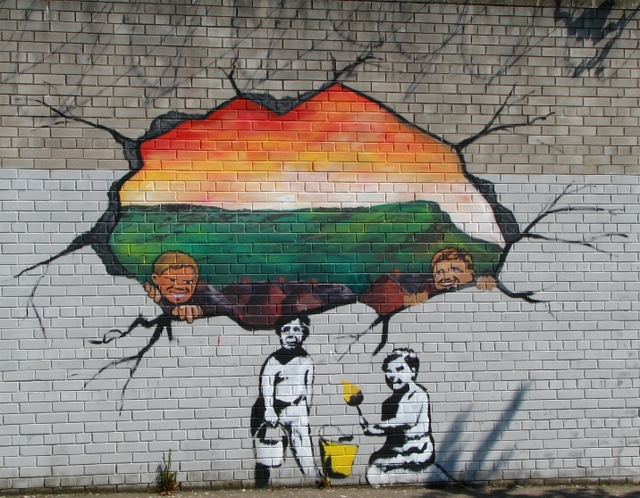
So, whether to advocate for peace or engage people in the struggle for justice, murals play an important role in mediating social change. In the case of the murals in Northern Ireland, the arts were not only used in an non-violent activist way, but also as a means to build peace and heal the community. Artists can raise awareness of latent local issues - or issues that are at the forefront of everyone's mind. Another example would be the the murals painted by Diego Rivera illustrating the repressed worker. These murals reflect not only Rivera's own communist leanings but also the political upheaval of the times and raised awareness of their struggle.
I find myself reflecting on this as I am very interested in the use of arts as a tool to facilitate community healing. The murals in Northern Ireland and Mexico City, the arts, were created as a means of public pedagogy and non-violent activism raising public awareness of issues and increase understanding and sympathy of others. At other times the arts may be used as a means towards gaining solace. In Kenya during the Truth and Reconciliation Commission, song was used when a particularly violent testimony was heard. Song, in this instance, seems to have been not only therapeutic for the audience of the Commission who had just acted as witnesses by listening to stories of human rights violations, it appears to have eased the stress for the witness and the commissioners.
So in order for arts to be used in a productive way during community healing, it important for to reflect on when to use the arts, in what instance to use them (consider environment) and what artistic medium is best suited for what situation. So really, the what, the when and the how are important considerations when using the arts in peace building approaches.
